
Security guarantees versus limitations
Agent Guard provides deterministic enforcement only for operations routed through a supported wrapper or blocking hook. It is not a universal operating-system sandbox.
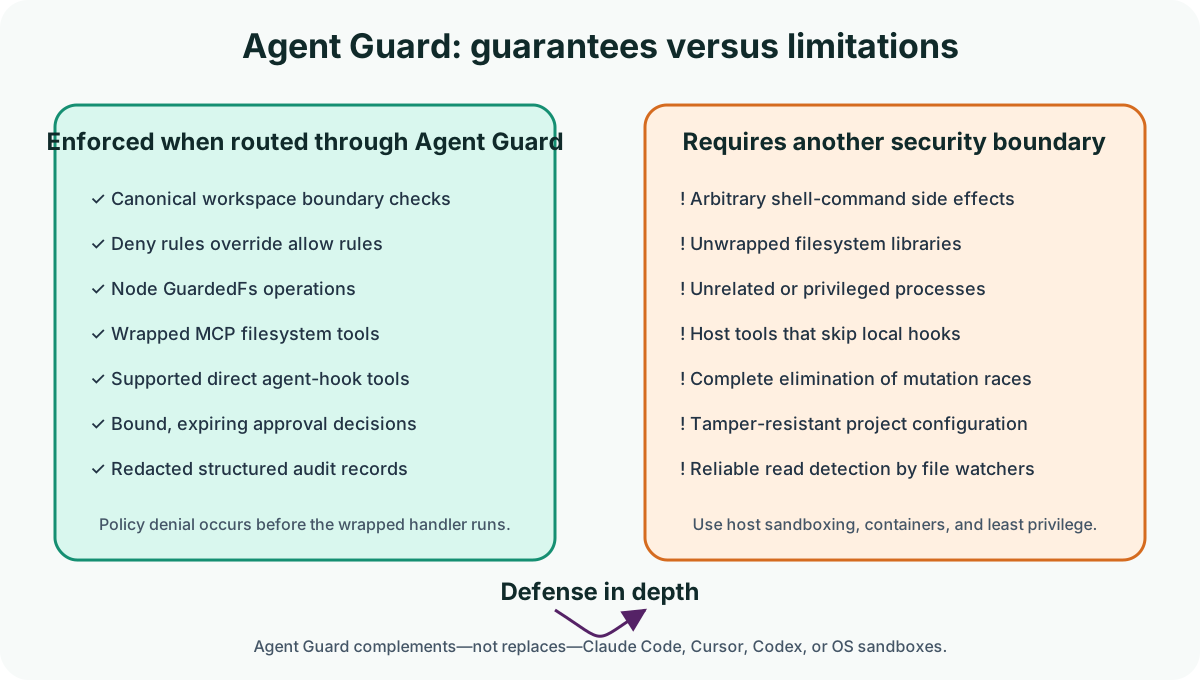
| Agent Guard guarantees | Agent Guard does not guarantee |
|---|---|
| Canonical path evaluation for supported operations | Interception of unrelated processes |
| Deny rules take precedence over allow rules | Confinement of an approved shell command |
| Denied wrapped handlers are not invoked | Coverage for host tools that bypass local hooks |
| Approval grants bind to agent, operation, and path | Tamper resistance when an attacker controls configuration |
| Audit records omit file contents | Perfect attribution from audit-only filesystem events |
| Sensitive-looking audit paths are redacted | Elimination of every path mutation race |
Recommended deployment
Use four layers together:
- Native agent controls: keep Claude Code permissions, Cursor run modes, and Codex sandboxing enabled.
- Agent Guard: apply project-specific paths, operation policies, approvals, and audit records.
- Process isolation: use a container, VM, or restricted OS account for untrusted autonomous workloads.
- Repository controls: require reviewed pull requests, secret scanning, and protected branches.
The threat-model article explains the reasoning and remaining risks in detail.